

What Is A Difficult Conversation?
One of the top reasons why we procrastinate when it comes to relationships is our inability to have difficult conversations. Especially, if it involves discussing a topic of concern that might irreversibly alter the status of the relationship going forward.
And what is a difficult conversation? Anything like firing someone, breaking up with someone (of course, Millennials and GenZs have a new way of doing it – Ghosting aka falling off the face of the earth in terms of returning text messages), or confront bias and prejudice, asking for a raise or confronting a family member about their irrational behavior.
Why Do We Shy From Difficult Conversations?
The reality is none of us has been taught what to say and what not to say when conflicts occur. That’s because no one likes to bring up the topic of difficult situations intentionally. But, that’s exactly what we need to do so that we can learn how to deal with tough issues when they arise.
Our lives are quite unpredictable and sooner or later, most of us find ourselves in tough spots. In those circumstances, we must respond rather than react. And that kind of a cool attitude can only come with intentionality and practice. Here are a few frameworks to help you deal with tough people and situations.
–

–
Facts, Feelings And Frameworks
ONE:
Imagine that person who’s argumentative and not willing to see others’ viewpoints. We all seem to have that one person in the board meeting.
The key is to coopt their side of the argument. Say this to engage them. “That’s a great point I didn’t consider. Thank you, that makes me wonder what others are thinking. Let’s ask everyone else in this room what they are thinking.”
This response makes it easy for the difficult person to see that there might be other opinions that are just as good or better than theirs. It also helps to stay on topic without getting personal about any response you have about their inputs.
TWO:
You have to give someone feedback on their performance. Whether we’re giving or receiving feedback, we are surrounded by anxiety. And that’s the paradox of feedback.
When giving feedback, if we are being as constructive and objective as possible, the better. And in schools they teach us how to first reinforce the positive behavior of the problem child and then introduce suggestions for improvement in other areas.
It’s the same here with adults, as we are pointing out their blindspots and areas of potential growth, we must also appreciate their strengths and contributions.
When receiving feedback, I always try to keep in mind this Telugu saying that I often heard growing up. “Vinadagu Nevvaru Cheppina” translates to “Listen to everyone no matter who they are”.
THREE:
Engaging with someone who’s not good at attention to detail. There are two parts to this. First, no one wants to do dirty work. And your own self-image of being the nice guy is being challenged when you have to tell people how they can do better. And, push this a little further, and one day you might be firing someone for underperforming or your company is having budget cuts.
The fear of giving feedback or expressing how you truly feel to confront someone stems from the fear what will happen to your identity. Are you now going to be perceived as the heartless monster? Fear is that defense mechanism of your brain to “not ruffle too many feathers” and continue to maintain that “good, positive, role model” image that you’ve so carefully constructed for yourself.
But, it’s time to put your feelings aside because what matters is our collaborative end goal and not your personal reputation in this case.
Second, for the person to whom you’re giving feedback, name the issue and then explain why working on it matters. For example, you can say something like this. “Please work on your critical thinking skills. It’s important for us to get the answers, yes, but getting them right is just as necessary. A deep dive on what you’re working on gives you the advantage of not overlooking anything as you put together a design solution for the project.”
FOUR:
Let’s look at the many different difficult interactions that happen in life.
Enter the classic blame game. Sometimes, we end up in a situation of no one’s fault. This can lead to a “What really happened?” conversation that can go on endlessly. Each side will then get into a rabbit hole of trying to find the elusive “truth behind the mess”. But, instead of focusing on who dropped the ball, it helps to think future forward.
The point is, how do we all get out of the mess and work together to resolve the problem for everyone’s benefit. What’s more, pointing fingers just causes more denial and conflict. It can even cloud the actual matter and create distractive problems of its own.
The other thing is, how to react when someone falsely accuses you. Whatever you do, avoid defending or refuting false allegations. Instead ask them to explain why they think so. Once you have the full picture of the real issue from their perspective, it will give you a chance to put forward your case instead of just reacting to their attack.
What if someone has a nature of always complaining. In such cases, you will quickly realize that there’s no use explaining anything to them. They might be the “Glass half empty” kind of people. Of course, if you’re in the business of customer service, and your client is complaining, explaining will only make their angrier as they think of you as coming up with excuses.
Instead, the golden rule is to acknowledge, apologize and act swiftly. “Why is there a delay in product shipment?” The answer can be “We’re working round the clock to resolve the issue and get it shipped ASAP.” Simple.
–
Beneath every behavior is a feeling. And beneath every feeling is a need. And when we meet that need rather than focus on the behavior, we begin to deal with the cause not the symptom. ~ Ashleigh Warner, Psychologist
–
Avoiding The Pitfalls Of Objectivity
During conflict resolution, any argument from either party cannot be just “facts” and be devoid of emotions. Persuasion tactics and collaborative conversations always involve the ethos of appealing to the other person’s emotions.
So, while its important to state the facts to get to the truth quickly, it is also important to acknowledge how the reality of the situation is affecting both parties involved.
Instead of assuming what the other person is feeling, it’s a good idea to label the emotions and strong feelings as part of the ongoing debate. It is necessary to acknowledge and validate how everyone’s feeling because it’s impossible to “set feelings aside” in search of truth.
Also, on the other side, if we wish to suppress our feelings, they will end up coming out as change of tone, voice and other body language signals. In fact, labeling emotions lends a certain amount of objectivity to how we’re feeling. So, it’s a good exercise to do it. They are your feelings about yourself and not your judgement about the other person. Same goes for the other person.
A General Rule For Reflective Pauses
Other difficult situations arise when you feel you’re being taken advantage of, or you see something online that you’re outrage about.
In all these cases, taking a step back before you respond helps. Ask yourself:
1. Is it worth saying what I am about to say?
2. What will happen if I don’t speak my mind?
3. How will the relationship be going forward?
4. What alternative things can I say or do?
In the end, anything can be resolved between two parties who are having difficulty communicating with each other. If only we can realize that each one of us is simply reacting to our perception and interpretation of the nature of reality in front of us.
To that end, it helps to explicitly state how each party is looking at the issue and feel about it, so that we can begin to resolve the situation in a way that works for everyone’s benefit. Good luck!
– 0 –
About The Article Author:
Hi, I’m Rachana. Its been my dream for years to do something to consciously create a better future where every one of us is excited about our own potential. My challenge to everyone is that they aspire for their personal best and leave a legacy of their work through their contributions to mankind.
One more thing. In December of 2044, I hope to win the Nobel.
Will you join me on this journey of growth and transformation?
Namasté.
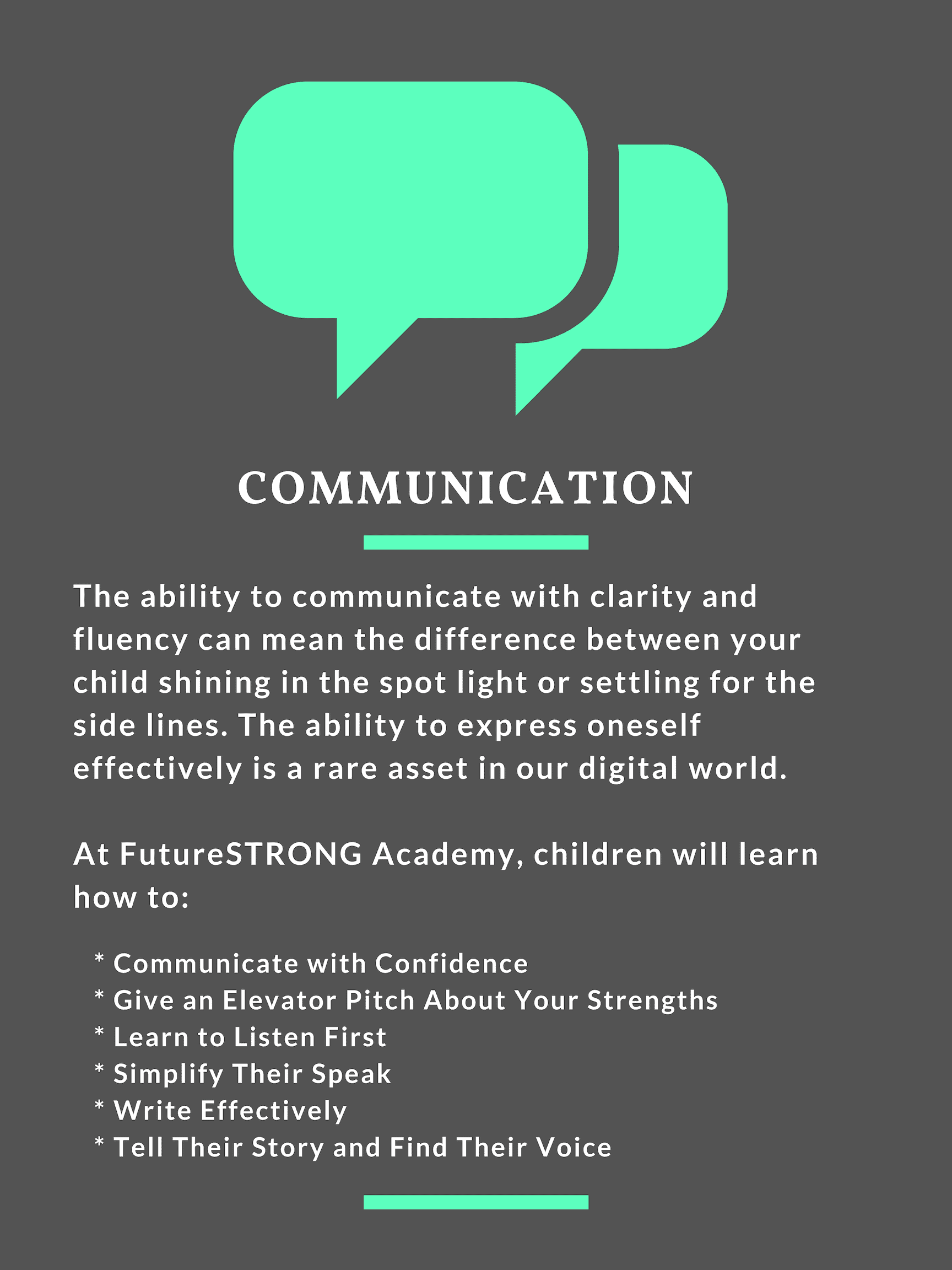
COMMUNICATION - A Pillar of FutureSTRONG Academy
Our children will one day face the real world without our support. Academic development is not the only skill they will need in the real world where people skills like taking the lead, emotional intelligence and a strong moral compass will determine who will shine. So, as parents who want to raise well rounded adults, we want to give them the right tools for their personal development.
Here is COMMUNICATION as described as the 6 C’s of Future STRONG.
Find Below Better Strategies On COMMUNICATION

Jeff Bezos’ Day 1 Mentality: Why Differentiation is the Key to Survival in Business and Life
- What makes you truly and uniquely "you"? Jeff Bezos has long championed the idea of a "Day 1" mentality - a relentless focus on staying agile, hungry, and innovative, as if Amazon were still a scrappy startup, even as it ballooned into a trillion-dollar...

Smartphones Are Rewiring Gen Z and Breaking the Workplace 🧠📵
- Want To Listen To The Article Instead? - How Smartphones Are Reshaping Gen Z and the Future of Work 🧠📵 At the 2025 World Economic Forum in Davos, experts raised alarms about how smartphones and constant screen time are dulling Gen Z’s...

Who Owns Ideas Anymore? How AI Is Hijacking the Internet’s Original Thinkers
- AI Has Turned Search Engines To Answer Engines I watched this video and understood that any of my original thoughts (well, are our thoughts ever original?) might just become a Chat GPT's prompt result, and I would never even know about it. And that's exactly...

Why People Are Falling in Love With ChatGPT and Leaving Their Spouses for AI
The Strange New Intimacy of AI There’s a man on YouTube who says ChatGPT sparked his spiritual awakening. He’s glowing, grinning, and talking about non-duality like he just came back from a 10-day Vipassana retreat. His wife, meanwhile, says it’s threatening...

Mechanize Wants to Replace All White-Collar Jobs With AI – Are We Ready for a Post-Work World?
- Want To Listen To The Article Instead? - Mechanize and the Future of White-Collar Automation 🤖 Mechanize, a bold new startup out of San Francisco, is aiming to do more than just optimize office work - it wants to replace it entirely. Co-founded...

The Future of AI: How to Build Ethical, Human-Centered Technology Without Falling Behind
Low Barrier Of Entry Means More Responsibility On Us Artificial Intelligence (AI) isn’t some distant, sci-fi dream anymore - it’s here, woven into the fabric of our lives, reshaping how we work, connect, and even think. But here’s the thing: with great...

Put Your Phone Down to Reclaim Your Life Says Angela Duckworth 🤳📵
- Put Your Phone Down, Pick Your Life Up: A Lesson from Angela Duckworth 🤳📵 "Where you physically place your phone may be one of the most consequential decisions you make." I just watched Angela Duckworth’s graduation speech at Bates College, and I have to tell...

Why Being Alone (With Intentionality) Is the New Superpower for Happiness and Growth 🧘♀️
- Want To Listen To The Article Instead? - The Joys of Chosen Solitude 🧘♀️ This article from the BBC explores a growing cultural shift towards embracing solitude and single living, distinguishing it from loneliness. It highlights a recent surge...

Anthropic Scanned Millions of Real Books to Train Claude AI 📚
- Want To Listen To The Article Instead? - Claude's Library: Training with Real Books 📚 Anthropic, the company behind the Claude AI model, acquired millions of physical print books and digitally scanned them to use as training data. This approach...

Empowering the Next Generation: How to Teach Kids Coding, Ethics, and Problem-Solving for a Brighter Future
Humanity Before Digital Citizenship Let me tell you something about the future. It’s not some distant, abstract concept - it’s being built right now, in classrooms, living rooms, and playgrounds around the world. And the kids? They’re not just bystanders....

I Sit, Scroll, Rot and Repeat. Yes, It Was The Damn Phones | A Powerful Poem By Kori Jane Spaulding 📵🤳
- Sit and Scroll and Rot 📵🤳 For years, I've been writing about all that Ms. Spaulding talks about in her poem "It was the damn phones". But, hearing this from someone like her from Gen Z stands out because she understands that "We are the product." The weight...

Why ChatGPT Gets It Wrong: Gary Marcus on AI’s Big Flaws and What We Must Fix
- Gary Marcus' Take On The AI Evolution Of Our Times 🤖 One of the most important videos you will hear about the state of AI innovation at the present moment ft. Gary Marcus. This is a discussion between Michael Walker from Novara Media with Gary Marcus, a...