

Why Do Conflicts Occur
Let us understand why we get into conflicts. With those older than us, we tend to see them as out of touch, slow and just not relevant. With those who are younger than us, we tend to see them as risk magnets, aggressive and lacking maturity.
We fight with our family because they are easily accessible to us. They are simply there, so it becomes easy to get into an argument with them over often inconsequential things. When family members question each other it’s easy to take it personally and assume a wrong accusatory intent behind their question.
The point is, most people mean well. Even absolute strangers to us don’t want to suffer unnecessarily or intentionally harm us. And this is a good assumption to have, especially since we are becoming an increasingly global world of different cultures and regions.
But, have we ever thought to look at anything or anyone without judgment, criticism and analysis. After all, nothing is as bad or as good as it looks.

Working Together Is Success
–
Four Typical Attitudes
Conflicts occur when one individual desires one thing while another wants something different. How well are you able to settle a dispute? It greatly depends on your attitude. Here are four different attitudes and how each one settles a dispute.
1. Aggressive: You LOSE/I WIN:
These kind of people never yield. It is not enough for them to just win, they also make sure that the other person loses.
2. Passive-Aggressive: You LOSE/I LOSE:
These kind of people give in most of the time, but find a method to undermine the other person. As long as the other person loses as well, it doesn’t really matter if they win.
3. Passive: I LOSE/You WIN.
These kind of people usually give in. They disregard what they want in order to maintain the calm.
4. Assertive: I WIN/You WIN
These kind of people compromise to get the most of what each party desires. Although they strongly advocate for themselves, they also want the other party to be happy.
5 Conflict Management Styles
So, how do you resolve and handle disputes? What style do you use to manage conflicts? According to Thomas and Kilman, at least one of the following five tactics is frequently used to handle conflict:
Avoiding
Accommodating
Competing
Compromising
Collaborating
The Thomas-Kilman conflict styles paradigm is depicted in this diagram. A person’s behavior can be classified along two categories in this model: assertiveness and cooperativeness. The degree to which someone makes an effort to allay their own worries is referred to as assertiveness. The degree to which one works to allay the anxieties of the other is referred to as cooperation.

The Thomas-Kilman Conflict-Styles Model
–
How Mindfulness Helps
The best antidote to conflict is being mindful. Instead of being consumed by the horror of diagnosis, prediction of loss and terror, why not live in the now, as things unfold in front of our eyes. Our life is much bigger than anyone of us individually, and we must learn to deal with everyone and ensure we make things work to our mutual benefit.
In the end, let us say that the situation has become beyond reaching a middle ground. Just then, try to practice this. For a little while, let the other person be right. We have not given importance to our position/stand and given priority to our peace of mind. That way, everyone wins. The other person’s ego and our peace.
– 0 –
About The Article Author:
Hi, I’m Rachana. Its been my dream for years to do something to consciously create a better future where every one of us is excited about our own potential. My challenge to everyone is that they aspire for their personal best and leave a legacy of their work through their contributions to mankind.
One more thing. In December of 2044, I hope to win the Nobel.
Will you join me on this journey of growth and transformation?
Namasté.
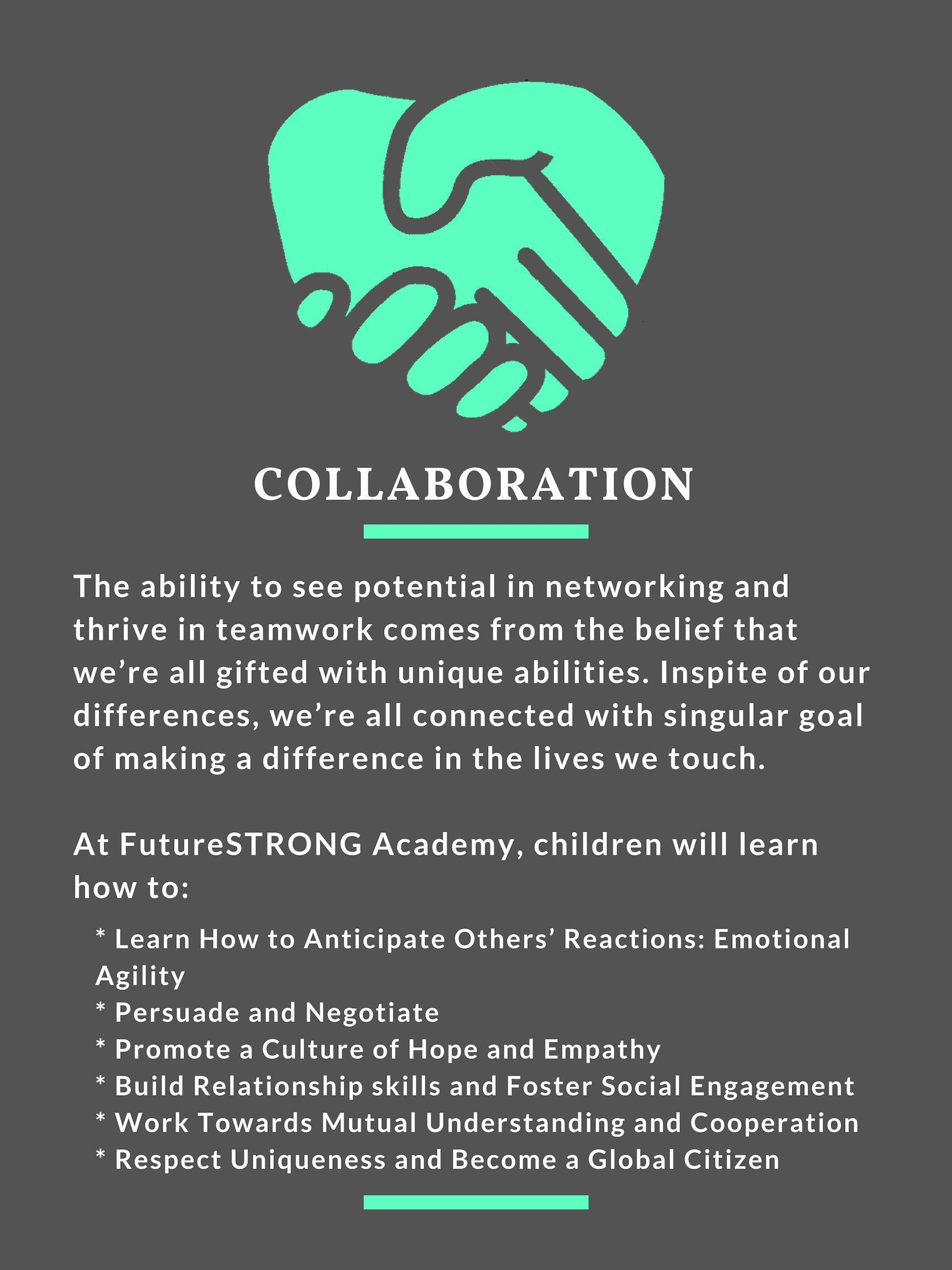
COLLABORATION - A Pillar of FutureSTRONG Academy
Our children will one day face the real world without our support. Academic development is not the only skill they will need in the real world where people skills like taking the lead, emotional intelligence and a strong moral compass will determine who will shine. So, as parents who want to raise well rounded adults, we want to give them the right tools for their personal development.
Here is COLLABORATION as described as the 6 C’s of Future STRONG.
Find Below Better Strategies On COLLABORATION

Why the War on Drugs Fails: Rethinking Incarceration, Addiction, and Justice Reform 🚨
- Want To Listen To The Article Instead? - The War on Drugs and Mass Incarceration 🚨 This article from RehabNet.com, discusses how the "War on Drugs" in the US has drastically increased incarceration rates. It highlights how drug offenses and...

How Entertainment Is Killing Public Discourse: Neil Postman’s Warning in the Age of Screens
- Want To Listen To The Article Instead? - Amusing Ourselves to Death: Public Discourse Americans no longer talk to each other, they entertain each other. They do not exchange ideas, they exchange images. They do not argue with propositions; they...

The Job Interview Isn’t Just a Test Anymore – It’s a Turing Test
Human Vs. AI A few of us who are in the business of hiring candidates for their teams have done this too many times by now, especially since the pandemic. We sit in front of the person who's being interviewed and usually they're on the other side of your...

Empathy: The Secret Weapon for a Human-Centered Digital Future You Can’t Ignore
- Want To Listen To The Article Instead? - Empathy In Action In a rapidly advancing digital world, empathy is more crucial than ever. Join us as we explore how fostering empathy can shape a human-centered digital future. Discover the importance of...

Why Pain Tolerance Beats Talent: The Grit Behind The Greatness Of Cornelius Vanderbilt
- Want To Listen To The Article Instead? - A Taste for Saltwater Most people treat discomfort like a warning sign - something to back away from. But the great ones? They read it as a green light. To them, discomfort isn’t a reason to stop; it’s...

Jeff Bezos’ Day 1 Mentality: Why Differentiation is the Key to Survival in Business and Life
- What makes you truly and uniquely "you"? Jeff Bezos has long championed the idea of a "Day 1" mentality - a relentless focus on staying agile, hungry, and innovative, as if Amazon were still a scrappy startup, even as it ballooned into a trillion-dollar...

Smartphones Are Rewiring Gen Z and Breaking the Workplace 🧠📵
- Want To Listen To The Article Instead? - How Smartphones Are Reshaping Gen Z and the Future of Work 🧠📵 At the 2025 World Economic Forum in Davos, experts raised alarms about how smartphones and constant screen time are dulling Gen Z’s...

Who Owns Ideas Anymore? How AI Is Hijacking the Internet’s Original Thinkers
- AI Has Turned Search Engines To Answer Engines I watched this video and understood that any of my original thoughts (well, are our thoughts ever original?) might just become a Chat GPT's prompt result, and I would never even know about it. And that's exactly...

Why People Are Falling in Love With ChatGPT and Leaving Their Spouses for AI
The Strange New Intimacy of AI There’s a man on YouTube who says ChatGPT sparked his spiritual awakening. He’s glowing, grinning, and talking about non-duality like he just came back from a 10-day Vipassana retreat. His wife, meanwhile, says it’s threatening...

Mechanize Wants to Replace All White-Collar Jobs With AI – Are We Ready for a Post-Work World?
- Want To Listen To The Article Instead? - Mechanize and the Future of White-Collar Automation 🤖 Mechanize, a bold new startup out of San Francisco, is aiming to do more than just optimize office work - it wants to replace it entirely. Co-founded...

Put Your Phone Down to Reclaim Your Life Says Angela Duckworth 🤳📵
- Put Your Phone Down, Pick Your Life Up: A Lesson from Angela Duckworth 🤳📵 "Where you physically place your phone may be one of the most consequential decisions you make." I just watched Angela Duckworth’s graduation speech at Bates College, and I have to tell...

Why Being Alone (With Intentionality) Is the New Superpower for Happiness and Growth 🧘♀️
- Want To Listen To The Article Instead? - The Joys of Chosen Solitude 🧘♀️ This article from the BBC explores a growing cultural shift towards embracing solitude and single living, distinguishing it from loneliness. It highlights a recent surge...
Thought provoking article.
Thank you so much!!