
Significance Of Makar Sankranti
The auspicious day of Makara Sankranti is the day dedicated to worship the Sun – whose light nourishes and sustains all life on this planet. Sankranti means Passage in Sanskrit.
Sankranti comes every month of the solar year when the sun moves from one sign of the zodiac to the next. The time when the sun changes direction from one constellation (of the zodiac) to another is known as Sankranti. And when the sun enters Capricorn, that is considered the most auspicious of all Sankrantis.
In Vedic astrology, Capricorn is known as “Makara” – the 10th sign of the Zodiac. Makara is a mythological animal, half-terrestrial and half-aquatic, and it is often depicted as a crocodile. It is considered to be a guardian of gateways and thresholds.
Makara Sankranti marks the beginning of the winter solstice. The sun’s northward journey Uttarayana begins on January 14th. Good things are expected to happen. Climate and the general ambience around us is expected to improve.
It is believed that children born during this period are naturally progressive, well mannered, pleasant and of noble disposition. Makara Sankranti, this time of renewal, is celebrated by different names all over India.
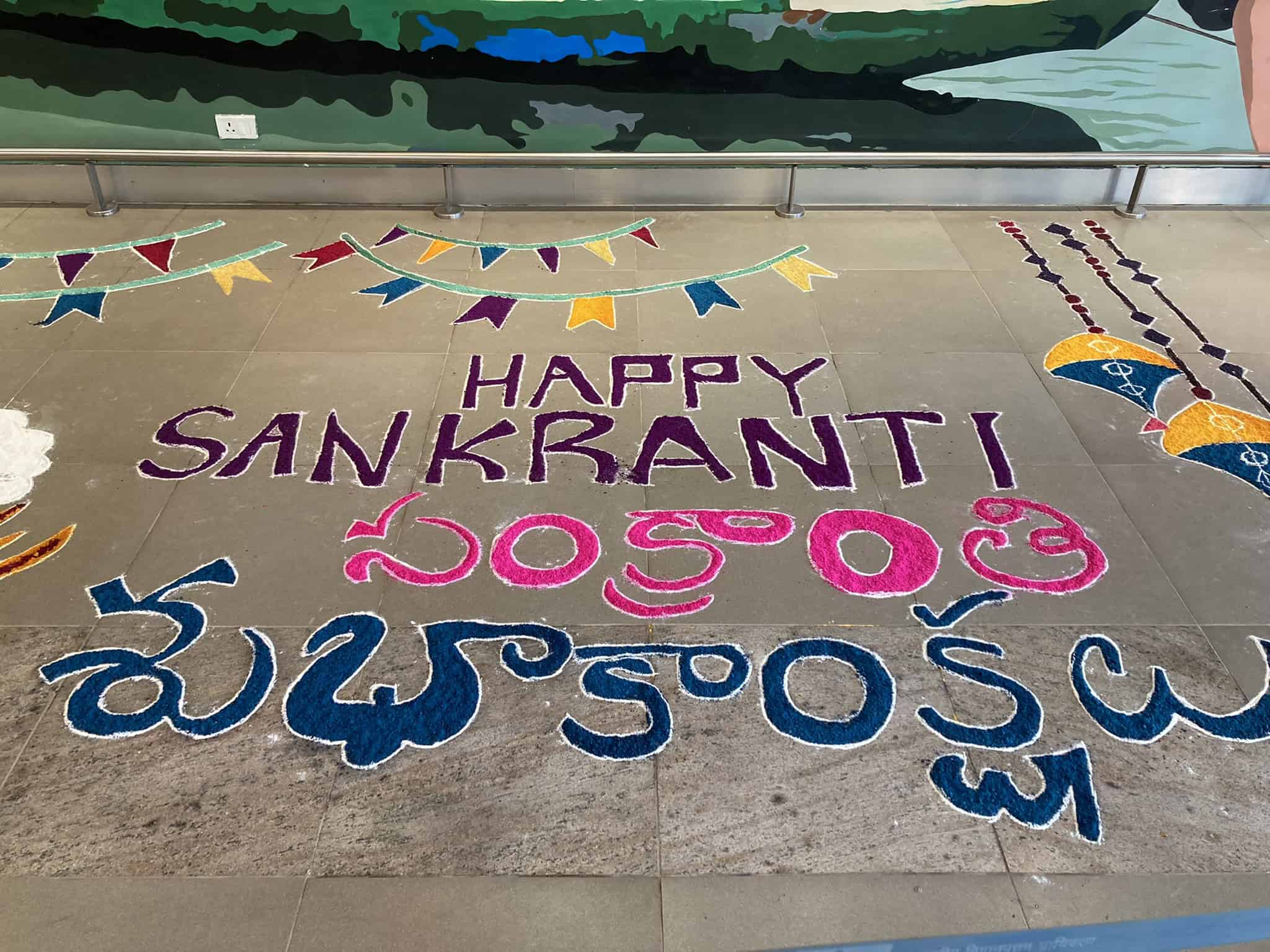
Festive Rangoli


–
Sankranti And Pongal Festivals Across India
The end of the southeast monsoon season and the harvest’s reaping are commemorated by the festivals of Pongal in the South and Sankranti in the North. Pongal’s arrival is related with spring cleaning and burning of junk in the house, which represents the destruction of evil.
In Uttar Pradesh it is called Khichri Sankranthi, as special Kichdi is made on that day. It is also called Til-Sankranti as laddoos with til are made and distributed. People take dips in rivers and worship the sun.
In Assam it is known as Bhogali Bihu – harvest festival. Bull fights are a major attraction of the festivities.
In Karnataka, Sankranti is celebrated with visiting friends and relatives and treat them with sweets and delicacies.
In Andhra Pradesh and Telangana it is called Sankranti or Gupi when the sons-in-law of the family are given a royal treatment. There will be a display of dolls for three days also called Bommala Koluvu. The three days of the festival are: Bhogi, Sankranti, and Kanuma.

Sankranti Bommala Koluvu
In Kerala it goes by the name Makara Jyoti or Villaku, which is celebrated with arati to Ayyappan at Shabarimalai.
In Gujrat, it is Patang (kite) Sankranti when the kites take the center stage. The sun is eclipsed by thousands of kites that soar in the sky. Sesame seeds are given as open gifts and laddoos of til are distributed. Kite flying conveys the message that God is holding the string of man, as He is the “Sutradhara”.
In Punjab and Haryana, Sankranti is known as LOHRI. Lohri marks the culmination of winter, and is celebrated on the 13th day in the month of Paush. The festival is celebrated to mark the end of winter. For Punjabis, this is more than just a festival; it is also the way of life. Lohri celebrates fertility and the spark of life. People gather round the bonfires, throw sweets, puffed rice and popcorn into the flames as an offering to the Sun God, the giver of all life, sing Lohri songs and exchange greetings. Men and women sing and dance, men do Bhangra and women Gidda. They make some offerings to the fire by saying – Aadar Aye, Dalidar Jaye – may honor come and let poverty go.
In Tamil Nadu, Pongal also marks the beginning of the Tamil month called Thai, which is considered an auspicious month. It usually falls on the 14th or 15th of January each year. The three days of the Pongal festival are called Bhogi Pongal, Surya Pongal, and Mattu Pongal. Decorative designs or rangolis are traced on floors and on the day of the Pongal, the newly harvested rice is cooked in homes to acclaim the bounty of the Gods.
One of the common themes of this festival as seen in many parts of the country is the distribution of a sweet called til-gul – the combination of til seeds and jaggery. The til brimming with fragrant and delicious oil stands for friendship and comradeship and jaggery for the sweetness of speech and behavior. The distribution of til-gul, therefore, forms a touching aspect of the Makara Sankramana celebration.
The Festival Of Lohri

Punjabi Lohri
–
Muggulu (Rangoli) In Front Of Homes In Andhra Pradesh


–
Leading With The Light From Within:
Light symbolizes warmth, i.e., love and affection, the quality of the heart. It is this supreme light and intelligence coupled with the warmth of the heart alone that can ultimately lead to all-round human harmony and happiness.
In addition to calling for the full blossoming of each person’s unique identity, Makara Sankramana also urges the awakening of all dormant energies within man for the benefit and glory of society as a whole.
Makara Sankramana embodies the ardent prayer of every Hindu heart –
Asato maa sadgamaya
Tamaso maa jyotirgamaya
Mrityormaa amritam gamaya
O Lord, lead me from the unreal to real; from the
darkness (of ignorance) to light (of knowledge); and
from death to immortality.
Call it Lohri, Pongal or Sankranti, the festival conveys the same message – the bond of brotherhood and the spirit of oneness should prevail above everything else.
Significance Of Ratham Muggu For Brotherhood: (Telugu)

–
Bhogi Pallu Festival During Sankranti


– 0 –
About The Article Author:
Hi, I’m Rachana. Its been my dream for years to do something to consciously create a better future where every one of us is excited about our own potential. My challenge to everyone is that they aspire for their personal best and leave a legacy of their work through their contributions to mankind.
One more thing. In December of 2044, I hope to win the Nobel.
Will you join me on this journey of growth and transformation?
Namasté.
About Sanatana Dharma
ब्रह्म सत्यं जगन्मिथ्या जीवो ब्रह्मैव नापरः।
अनेन वेद्यं सच्छास्त्रमिति वेदान्तडिण्डिमः॥
Brahman alone is real; the universe is mithya – neither fully real nor unreal, but an appearance. The individual self (jiva) is none other than Brahman itself, not separate or different. This is the true teaching of the scriptures, as revealed by Vedanta. ~ Verse 20 from Brahma Jnānavali Māla

Unveiling the Bhagavad Gita: Timeless Wisdom for a Fulfilling Life (Part 1)
- When we look at him for advice, help or direction for our problems, we hear Bhagwan say, "Sarva-dharman parityajya mam ekam saranam vraja: "Give up all other duties and surrender unto Me." This is Chapter 18, Verse 66 of the Gita. He says, "yoga-kshemam...

Unmasking the 6 Mind Sharks: How to Conquer Negative Thinking (Sanat Kumara Secrets)
- According to the sages - the Sanat Kumaras, the six ferocious sharks of the mind are Lust, Anger, Greed, Pride, Delusion and Jealousy. How to get rid of these sharks of the mind and senses? 1. Lust - (Desire, Craving, Yearning). Get rid of the first shark of...

Chariot Your Way to Success: Unveiling the Bhagavad Gita’s Life Goal Metaphor
The Chariot Metaphor To understand the glory of Gita is to understand the glory of the self. When we imbibe the meaning of the Gita, we begin the journey from traveling from the Jeevatma to the Paramatma and recognize that they are one and the same. Since Gita...

Unlock Your Inner Wisdom: Hindu Teachings on How to Think Clearly and Live Fully
Mind Vs. The Intellect Our mind is our instrument of thinking. It is a seat to emotions like: love, compassion, anger, greed etc. The mind brings us desires, intentions, imagination and ideas. It uses sense organs to feel happiness via external stimuli. What it...

Dussehra 2023: Celebrating Lord Rama’s Homecoming and the Triumph Over Ravana | Future Strong
- Dussehra indicates as the word suggests, DASA-PAPA-HARA, the end or liquidation of ten sins. The ten sins are attributed to the 10 sense-organs through which the mind contacts and gains knowledge of the phenomenal world, and also reacts to the stimuli...


Rituals or Superstitions? Unraveling the Why Behind Hindu Traditions
Half Saree And Dhoti Ceremony This a ritual practiced by many societies in south India. Coming of age generally signifies a boy or a girl is mature enough to understand his responsibility towards family and society. Dhoti Ceremony is an Indian Hindu ceremony...

Essential Hindu Terms & Definitions Explained: A Beginner’s Guide to Understanding Hinduism
What Are Tantras? A Hindu or Buddhist mystical or ritual text, dating from the 6th to the 13th centuries. It has the importance of adherence to the doctrines or principles of the tantras, involving mantras, meditation, yoga, and ritual. What is Surrender?...

Master Hindu Scriptures with Swami Chinmayananda’s Study Scheme – A Complete Guide to Spiritual Wisdom
- For those interested in the scheme of study of Gurudev's literature, here's a reccomendation of how to go about his works. His works show us a practical application of Vedanta to life. © Chinmaya Mission - 0 - About Sanatana Dharma ब्रह्म सत्यं...

Timeless Wisdom: The Moral Values of Panchatantra Tales You Need to Know Today!
- The Panchatantra is a legendary collection of short stories from India. Originally composed in the 2nd century B.C, Panchatantra is believed to be written by Vishnu Sharma along with many other scholars. The purpose behind the composition was to implant moral...

My India by Swami Paramahamsa Yogananda: Timeless Wisdom on Indian Culture and Spirituality
- Not where the musk of happiness blows,Not where darkness and fears never tread;Not in the homes of perpetual smiles,Nor in the heaven of a land of prosperityWould I be bornIf I must put on mortal garb once more. Dread famine may prowl and tear my...

The 8 Types of Hunger: Master Mindful Eating and Transform Your Relationship with Food
EYE HUNGER Eye hunger is triggered by food that you see. It can be other people who are eating, food that you see on the table or counter, seeing adverts, recipes and pictures of food. Other examples are food displays in delis, markets, restaurants or...