Significance Of Makar Sankranti
The auspicious day of Makara Sankranti is the day dedicated to worship the Sun – whose light nourishes and sustains all life on this planet. Sankranti means Passage in Sanskrit.
Sankranti comes every month of the solar year when the sun moves from one sign of the zodiac to the next. The time when the sun changes direction from one constellation (of the zodiac) to another is known as Sankranti. And when the sun enters Capricorn, that is considered the most auspicious of all Sankrantis.
In Vedic astrology, Capricorn is known as “Makara” – the 10th sign of the Zodiac. Makara is a mythological animal, half-terrestrial and half-aquatic, and it is often depicted as a crocodile. It is considered to be a guardian of gateways and thresholds.
Makara Sankranti marks the beginning of the winter solstice. The sun’s northward journey Uttarayana begins on January 14th. Good things are expected to happen. Climate and the general ambience around us is expected to improve.
It is believed that children born during this period are naturally progressive, well mannered, pleasant and of noble disposition. Makara Sankranti, this time of renewal, is celebrated by different names all over India.
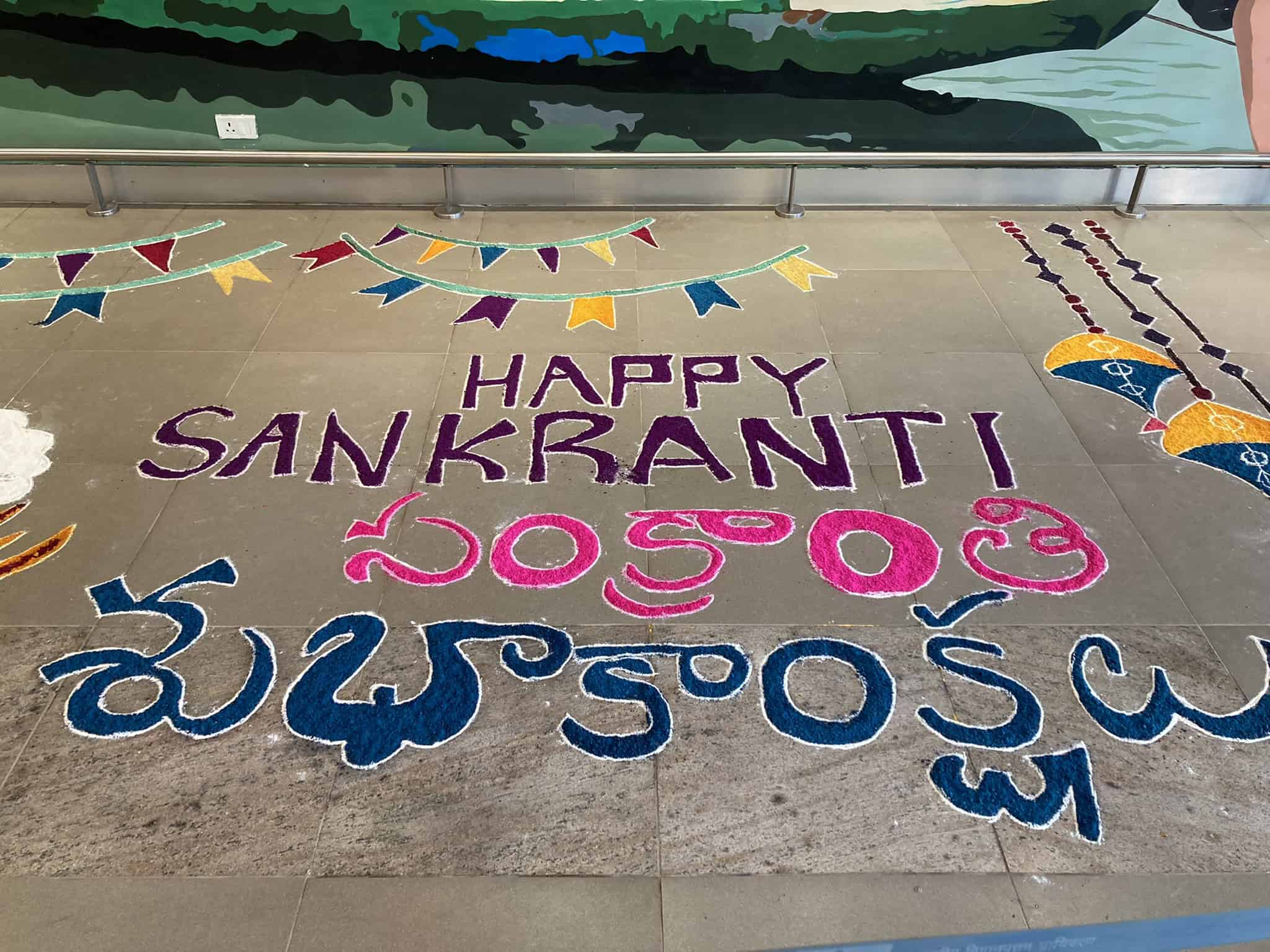
Festive Rangoli


–
Sankranti And Pongal Festivals Across India
The end of the southeast monsoon season and the harvest’s reaping are commemorated by the festivals of Pongal in the South and Sankranti in the North. Pongal’s arrival is related with spring cleaning and burning of junk in the house, which represents the destruction of evil.
In Uttar Pradesh it is called Khichri Sankranthi, as special Kichdi is made on that day. It is also called Til-Sankranti as laddoos with til are made and distributed. People take dips in rivers and worship the sun.
In Assam it is known as Bhogali Bihu – harvest festival. Bull fights are a major attraction of the festivities.
In Karnataka, Sankranti is celebrated with visiting friends and relatives and treat them with sweets and delicacies.
In Andhra Pradesh and Telangana it is called Sankranti or Gupi when the sons-in-law of the family are given a royal treatment. There will be a display of dolls for three days also called Bommala Koluvu. The three days of the festival are: Bhogi, Sankranti, and Kanuma.

Sankranti Bommala Koluvu
In Kerala it goes by the name Makara Jyoti or Villaku, which is celebrated with arati to Ayyappan at Shabarimalai.
In Gujrat, it is Patang (kite) Sankranti when the kites take the center stage. The sun is eclipsed by thousands of kites that soar in the sky. Sesame seeds are given as open gifts and laddoos of til are distributed. Kite flying conveys the message that God is holding the string of man, as He is the “Sutradhara”.
In Punjab and Haryana, Sankranti is known as LOHRI. Lohri marks the culmination of winter, and is celebrated on the 13th day in the month of Paush. The festival is celebrated to mark the end of winter. For Punjabis, this is more than just a festival; it is also the way of life. Lohri celebrates fertility and the spark of life. People gather round the bonfires, throw sweets, puffed rice and popcorn into the flames as an offering to the Sun God, the giver of all life, sing Lohri songs and exchange greetings. Men and women sing and dance, men do Bhangra and women Gidda. They make some offerings to the fire by saying – Aadar Aye, Dalidar Jaye – may honor come and let poverty go.
In Tamil Nadu, Pongal also marks the beginning of the Tamil month called Thai, which is considered an auspicious month. It usually falls on the 14th or 15th of January each year. The three days of the Pongal festival are called Bhogi Pongal, Surya Pongal, and Mattu Pongal. Decorative designs or rangolis are traced on floors and on the day of the Pongal, the newly harvested rice is cooked in homes to acclaim the bounty of the Gods.
One of the common themes of this festival as seen in many parts of the country is the distribution of a sweet called til-gul – the combination of til seeds and jaggery. The til brimming with fragrant and delicious oil stands for friendship and comradeship and jaggery for the sweetness of speech and behavior. The distribution of til-gul, therefore, forms a touching aspect of the Makara Sankramana celebration.
The Festival Of Lohri

Punjabi Lohri
–
Muggulu (Rangoli) In Front Of Homes In Andhra Pradesh


–
Leading With The Light From Within:
Light symbolizes warmth, i.e., love and affection, the quality of the heart. It is this supreme light and intelligence coupled with the warmth of the heart alone that can ultimately lead to all-round human harmony and happiness.
In addition to calling for the full blossoming of each person’s unique identity, Makara Sankramana also urges the awakening of all dormant energies within man for the benefit and glory of society as a whole.
Makara Sankramana embodies the ardent prayer of every Hindu heart –
Asato maa sadgamaya
Tamaso maa jyotirgamaya
Mrityormaa amritam gamaya
O Lord, lead me from the unreal to real; from the
darkness (of ignorance) to light (of knowledge); and
from death to immortality.
Call it Lohri, Pongal or Sankranti, the festival conveys the same message – the bond of brotherhood and the spirit of oneness should prevail above everything else.
Significance Of Ratham Muggu For Brotherhood: (Telugu)

–
Bhogi Pallu Festival During Sankranti


– 0 –
About The Article Author:
Hi, I’m Rachana. Its been my dream for years to do something to consciously create a better future where every one of us is excited about our own potential. My challenge to everyone is that they aspire for their personal best and leave a legacy of their work through their contributions to mankind.
One more thing. In December of 2044, I hope to win the Nobel.
Will you join me on this journey of growth and transformation?
Namasté.
About Sanatana Dharma
ब्रह्म सत्यं जगन्मिथ्या जीवो ब्रह्मैव नापरः।
अनेन वेद्यं सच्छास्त्रमिति वेदान्तडिण्डिमः॥
Brahman alone is real; the universe is mithya – neither fully real nor unreal, but an appearance. The individual self (jiva) is none other than Brahman itself, not separate or different. This is the true teaching of the scriptures, as revealed by Vedanta. ~ Verse 20 from Brahma Jnānavali Māla

Sri Rama Navami: Rama Bhajans, the Sacred Journey of Dharma, and the Birth of Lord Rama
Sri Rama Navami celebrates the birth of Lord Rama. It is observed on the ninth day of the spring festival that begins with the Lunar New Year, which is celebrated across different regions of India under various names, such as Ugadi among Telugu communities. It falls...

Sri Rama Rama Bhajan: The Chant For Each Divine Name Of Lord Rama
Hi all,I enjoyed singing this, as its a beautiful string of epithets for Lord Rama, each highlighting a different divine quality or a stage of his life. For the first time I added the tanpura in the background. Hope you like it. Bhajan Lyrics: Sri Rama Rama...


Ramachandraya Janaka: The Mangalam Song That Ends Carnatic Concerts & Prayer Sessions with Blessings
Hi all,Ramachandraya Janaka is a classic "Mangalam" that's often sung at the end of concerts or puja ceremonies to invoke blessings and peace. Thank you for listening. Hope you like it. Here are the lyrics: rāmachandrāya janakarājajā manōharāyamāmakābhīṣṭadāya...

The Two Logs in the River: A Ramayana Lesson on Love, Detachment, and Living Fully
Shlokas As Compass Ever since I understood the meaning of a shloka of Adi Shankara's from Bhaja Govindam, I've tried to use it as a way to operationalize my spiritual journey. Shankara says, Satsangatve nissangatvam,Nissangatve nirmohatvam,Nirmohatve...

The Artist Who Defined Hindu Mythology for Millions of Kids: The Magical Illustrations of Vaddadi Papaiah
We all know this scene as the iconic scene from the movie Bahubali - a drowning mother's hand holding a baby above the water. But not many of us know that this was inspired by a drawing by the legendary illustrator Vaddadi Papayya. After the devastating 1977 Diviseema...

The Chariot of Life: Ancient Wisdom from the Bhagavad Gita for Modern Living
I grew up seeing the image of Krishna and Arjuna in a chariot in cafes, restaurants, homes and function halls. I had no idea what it had meant until way into my 30's. The Chariot of life from the story of Mahabharata in Bhagavad Gita is a metaphor that explains the...

Entamatramu Bhakti Keerthana: A 15th Century Song That Teaches the Secret of Being Limitless
Be Limitless - A 600 Year Old Definition Every day, I feel blessed with miracles around me. This past weekend, my sister sent me a link to a song I'd never heard before. The moment I listened, I was seized by its essence. It felt like a direct invitation to...

Finding Your Alignment: An Indian American Woman’s Guide to Living Fully in America
Rooted, Rising, and Reckoning As a life coach and friend to many from the Indian diaspora, I often find myself in the sacred space of listening to Indian American women juggling life and priorities in America as mothers, professionals, and social change...

Prabhu Ramachandra Ke Dootha: The Divine Power of Hanuman That Awakens Strength, Faith & Fearlessness
Hi all,I had so much fun practicing this. And my teacher asked us to imagine Hanuman sitting in front of us listening in on our devotion for him. Hope you like it. Here are the lyrics: Prabhu Ramachandra Ke Dootha Hanumantha AnjaneyaPrabhu Ramachandra Ke Dootha...

Chandra Shekaraaya Namah Om: The Sacred Om Namah Shivaya Chant
Chandrashekhara is the one who wears the moon and Gangadhara is the one that holds the Ganga, they are tributes to the many attributes of Lord Shiva. Featured Image: This 12-foot monolithic stone Shiva Linga is located in Kanli Bagh, Baramulla, Kashmir. Thank...

Shankara Shankara Shiva Shambo: A Transcendental Journey into Shiva Consciousness
There is a unique magic in the duality of Lord Shiva — the stillness of the meditator and the cosmic dance of the Nataraja. Whether you need to find your fire or find your peace, I hope these chants serve as a bridge to the divine. Thank you for listening. ...