

Why Do Conflicts Occur
Let us understand why we get into conflicts. With those older than us, we tend to see them as out of touch, slow and just not relevant. With those who are younger than us, we tend to see them as risk magnets, aggressive and lacking maturity.
We fight with our family because they are easily accessible to us. They are simply there, so it becomes easy to get into an argument with them over often inconsequential things. When family members question each other it’s easy to take it personally and assume a wrong accusatory intent behind their question.
The point is, most people mean well. Even absolute strangers to us don’t want to suffer unnecessarily or intentionally harm us. And this is a good assumption to have, especially since we are becoming an increasingly global world of different cultures and regions.
But, have we ever thought to look at anything or anyone without judgment, criticism and analysis. After all, nothing is as bad or as good as it looks.

Working Together Is Success
–
Four Typical Attitudes
Conflicts occur when one individual desires one thing while another wants something different. How well are you able to settle a dispute? It greatly depends on your attitude. Here are four different attitudes and how each one settles a dispute.
1. Aggressive: You LOSE/I WIN:
These kind of people never yield. It is not enough for them to just win, they also make sure that the other person loses.
2. Passive-Aggressive: You LOSE/I LOSE:
These kind of people give in most of the time, but find a method to undermine the other person. As long as the other person loses as well, it doesn’t really matter if they win.
3. Passive: I LOSE/You WIN.
These kind of people usually give in. They disregard what they want in order to maintain the calm.
4. Assertive: I WIN/You WIN
These kind of people compromise to get the most of what each party desires. Although they strongly advocate for themselves, they also want the other party to be happy.
5 Conflict Management Styles
So, how do you resolve and handle disputes? What style do you use to manage conflicts? According to Thomas and Kilman, at least one of the following five tactics is frequently used to handle conflict:
Avoiding
Accommodating
Competing
Compromising
Collaborating
The Thomas-Kilman conflict styles paradigm is depicted in this diagram. A person’s behavior can be classified along two categories in this model: assertiveness and cooperativeness. The degree to which someone makes an effort to allay their own worries is referred to as assertiveness. The degree to which one works to allay the anxieties of the other is referred to as cooperation.

The Thomas-Kilman Conflict-Styles Model
–
How Mindfulness Helps
The best antidote to conflict is being mindful. Instead of being consumed by the horror of diagnosis, prediction of loss and terror, why not live in the now, as things unfold in front of our eyes. Our life is much bigger than anyone of us individually, and we must learn to deal with everyone and ensure we make things work to our mutual benefit.
In the end, let us say that the situation has become beyond reaching a middle ground. Just then, try to practice this. For a little while, let the other person be right. We have not given importance to our position/stand and given priority to our peace of mind. That way, everyone wins. The other person’s ego and our peace.
– 0 –
About The Article Author:
Hi, I’m Rachana. Its been my dream for years to do something to consciously create a better future where every one of us is excited about our own potential. My challenge to everyone is that they aspire for their personal best and leave a legacy of their work through their contributions to mankind.
One more thing. In December of 2044, I hope to win the Nobel.
Will you join me on this journey of growth and transformation?
Namasté.
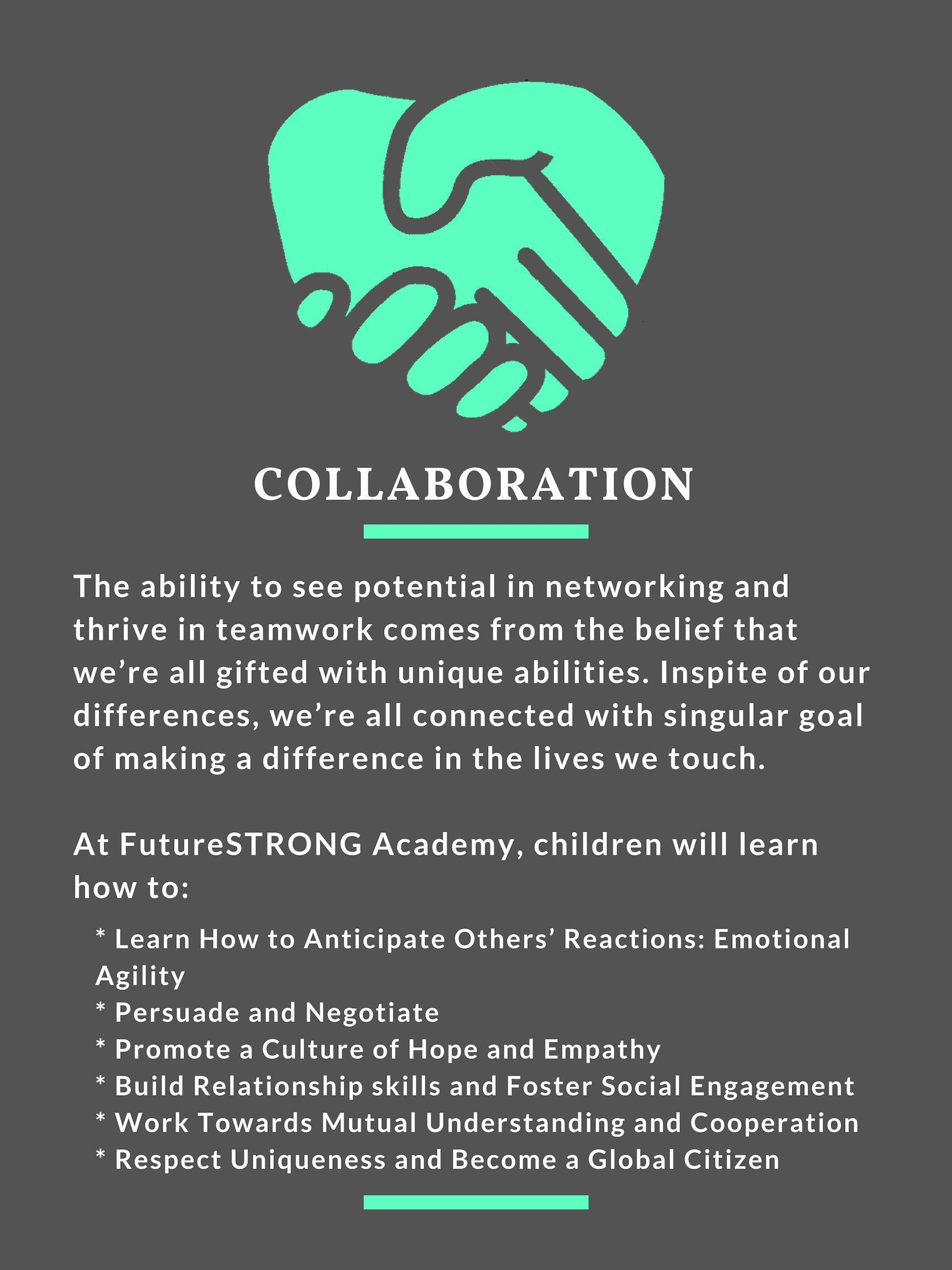
COLLABORATION - A Pillar of FutureSTRONG Academy
Our children will one day face the real world without our support. Academic development is not the only skill they will need in the real world where people skills like taking the lead, emotional intelligence and a strong moral compass will determine who will shine. So, as parents who want to raise well rounded adults, we want to give them the right tools for their personal development.
Here is COLLABORATION as described as the 6 C’s of Future STRONG.
Find Below Better Strategies On COLLABORATION

AI Is Coming for Your Job – Unless You Upskill Fast, Warns Fiverr CEO Micha Kaufman
- Want To Listen To The Article Instead? - Upskill or Be Left Behind: AI's Impact on Jobs 🤖 Fiverr CEO Micha Kaufman's warns his staff via an email to his staff about the impact of AI on jobs, including his own. Kaufman emphasizes the need for...

The AI Skills Gap Is Getting Wider – Here’s How to Survive the Shift Before Your Job Disappears
- Want To Listen To The Article Instead? - Bridging the AI Skills Divide These articles discuss the disconnect in perceptions of AI skills between business leaders and employees. Leaders prioritize AI proficiency for advancement and hiring, while...

How to Empower the Women in Your Life (Without Becoming a TED Talk)
- No Hashtags or Capes Required Let me say something radical. You don’t have to be a superhero or an activist or someone on LinkedIn who uses the words “passionate about equity” to change a woman’s life. You actually don’t even have to be a woman. You just have...

🚨 Sexting & Sextortion: The Hidden Online Dangers Every Parent Must Talk to Their Kids About Today
- How Can Kids Stay Safe Online If you're reading this, you probably have a child who’s navigating the online world - or will be soon. And as someone who sees the internet as both a tool and a trap, I want to sound the alarm, not to scare you, but to prepare...

Conquer Your Career: Scrum Master, Agile Coach & PMP Exam Prep (Part V)
- Continued From Part IV HERE - Interview And Test Prep For Agile, Scrum And PMP Roles: #Q1: What is MoSCoW prioritization, and how does it work?A:MoSCoW is a prioritization framework that categorizes work into four buckets:- M (Must have):...

Brain Rot and the Death of Focus: How Trivial Content Is Reshaping Our Minds
- Want To Listen To The Article Instead? - The Impact of Trivial Online Content 🧠🎯 Brain rot is Oxford's 2024 Word of the Year. It explains that young people on social media commonly use this term to describe a perceived decline in mental or...

The 5 Levels of Wealth: Your Roadmap to Financial Freedom Explained By Sahil Bloom
- Want To Listen To The Article Instead? - Summary The five distinct stages of financial wealth outlines a progression starting from meeting basic needs in Level 1 to achieving complete financial independence with all pleasures accessible in Level...

How Parents Can Recognize Suicide Warning Signs and Offer Life-Saving Support
- Warning Signs of Suicide As parents and family members, it’s crucial to be aware of the warning signs of suicide and know how to support your loved ones during difficult times. The Center for Mental Health Care and Resources at Georgia Tech has compiled...

Master the Art of Problem-Solving with These 6 Powerful Mental Models
How I Outsmart Problems (Most Days) Using Mental Models OK, so life is basically one long group project, right? There’s a mess to clean up, someone forgot the deadline, and nobody wants to take notes. Enter: mental models. These are like cheat codes for...

From the Classroom to the Ball Field: 7 Game-Changing Lessons from David Perkins
- Transforming Education: What Baseball Can Teach Us About Learning Whole David N. Perkins, a leading thinker in education and co-director of Project Zero at Harvard, presents a compelling case for transforming how we teach by emphasizing learning as a whole...

10 Life-Changing Money Lessons from The Psychology of Money to Build Massive Wealth
The Psychology of Money by Morgan Housel Alright, let’s break this down in a way that feels natural, like we’re sitting across from each other, sipping coffee, and talking about life, money, and the messy, beautiful journey of building something meaningful....

From A Mediocre Coder To Now – My Journey To Help Others Decode Life
SHORT PERSONAL BIO In 2011, when I was working in the IT department of the Mental Health division of Georgia, my boss was a kind middle aged man. What was special about John was that he had a unique gift of understanding people and working with them...
Thought provoking article.
Thank you so much!!