

Surviving Not Thriving
We want our children – Resilient, Decisive and Compassionate. But, how many minutes a day do we spend nurturing these qualities in them?
All day, every day, we as parents act in full blown survival mode. And we feel like our ultimate goal is to ensure our children are not bored at any cost.
Our Current State of Busyness
But, let’s face it, real life is not naturally stimulating. In fact, it’s nothing but long stretches of boring loneliness with bursts of temporary excitement in groups of 2 people or more. The sooner we teach our children this the better.
Also, in juxtaposition, our day-to-day, monotonous lives pale in comparison to our online lives which are very unpredictable and exciting with plenty of likes and comments. That’s why so many of us are struggling “to find meaning in our boring lives” especially since 2011 with the massive intrusion of social media and its excitement in our lives.
Such is our modern life where taking some downtime is mistaken for laziness and lack of motivation. In our crazy busyness, we’re forgetting to remind ourselves that our bodies and minds need downtime. And that we don’t always have to be on the go to be productive.
–
“When you press the pause button on a machine, it stops. But when you press the pause button on human beings they start,” argues my friend and teacher Dov Seidman, CEO of LRN, which advises global businesses on ethics and leadership. “You start to reflect, you start to rethink your assumptions, you start to reimagine what is possible and, most importantly, you start to reconnect with. ”
~ Thomas L. Friedman, Thank You for Being Late: An Optimist’s Guide to Thriving in the Age of Accelerations
–
Daydreaming For Problem Solving
We all know, busyness is not productivity. And here’s the thing. Downtime provides huge benefits to brain health.
Boredom allows our brains to connect the dots between our thoughts and our experiences, and helps problem solving.
Allowing our brains to get off the “always on the go” mode means allowing it to wander once in a while. When we are day dreaming, we start using our subconscious thinking, which means we are making all sort of connections between things from our past and the things we’ve learnt. That’s when we start making inroads into issues that are bothering us because we start making discoveries, finding patterns and finding out new ways to old nagging problems.
The Brain on Default Mode
What’s more, pausing literally changes the brain’s structure. Silent moments of mindfulness actually enables the formation of more folds in the prefrontal cortex (PFC). The process is called gyrification. This is really important because the PFC is the executive branch of the brain – it aids in processing feelings, regulating emotions, cognitive flexibility and decision making.
Our brain is said to be in the “Default Mode Network” during the process of self-reflection – the psychological task of reflecting on one’s traits and characteristics. This self-reflection aids in what is called “Autobiographical Planning” which takes a note of how we tell ourselves stories of our past and our future – in a way to connect different experiences to translate them into ideas for our most persistent problems.
Frequent and consistent brain breaks give our brain a chance to shift its focus away to something low-stakes and fun for a few minutes. They are also shown to boost productivity and creativity once we return to our learning tasks. What’s more, seeking refuge in silence allows us to give grace to ourselves and to others around us.

I’m Busy But Not In The Way You Think
–
Boost Creativity Through Boredom
The funny thing about humans is that so many of us want to live 100 years when we don’t know what to do with a boring Sunday afternoon.
So, try something new in life. Pick up a new skill, try a new recipe or learn to dance. Mental agility that’s aided with novelty and calculated risks set us on a path of growth and learning for a lifetime.
And, let’s teach our children to pause once in a while. Let’s encourage our children to day dream. Let their boredom not be rescued by YouTube all the time. Let them find their own stimulation. Create opportunities where they can have brain breaks like taking a walk, or meditation. It will also allow us to have that terrifying thing called a “deep conversation” with our loved ones.
Whether they grab a book and fall into the couch, or grab their headphones and go for a run – what children do with their time is up to them. But it’s our duty to tell them that a little downtime once in a while will reset the brain to think, create and connect more efficiently.
Slowing Down In The Present For a Better Future
The upside to Covid has been our physical lives have been more or less slowed down to the natural pace it was meant to be. Now, its upto us to start living our mental spaces at the same pace. Adopt digital minimalism to declutter that space in your head and start anew.
It’s going to be difficult in the beginning, but existential boredom is good. It’s good for the soul, because you actually can sort through your thoughts and create priorities. Research shows us that when the brain in under stimulated, it starts looking for self stimulation boosting creativity.
In the end, slowing down to the pace of nature helps us to check if the route we’re on in life is the one that we actually want to be on. After all, whatever we might be navigating – boroughs or board rooms, we’ll need tools like wonder, boredom, resilience, gratitude, creativity. And it starts with us capturing those moments of stillness around our daily grind.
– 0 –
About The Article Author:
Hi, I’m Rachana. Its been my dream for years to do something to consciously create a better future where every one of us is excited about our own potential. My challenge to everyone is that they aspire for their personal best and leave a legacy of their work through their contributions to mankind.
One more thing. In December of 2044, I hope to win the Nobel.
Will you join me on this journey of growth and transformation?
Namasté.
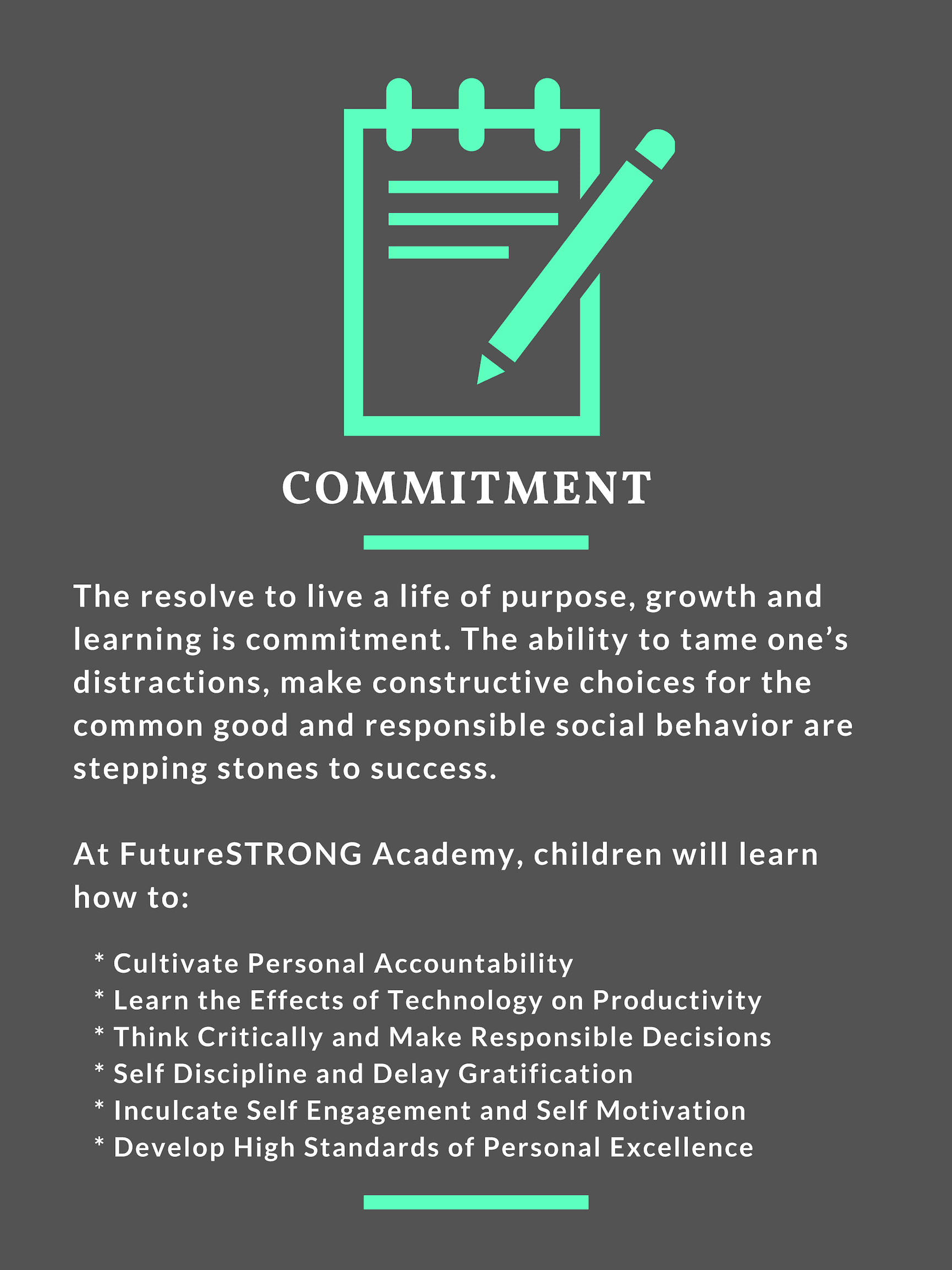
COMMITMENT - A Pillar of FutureSTRONG Academy
Our children will one day face the real world without our support. Academic development is not the only skill they will need in the real world where people skills like taking the lead, emotional intelligence and a strong moral compass will determine who will shine. So, as parents who want to raise well rounded adults, we want to give them the right tools for their personal development.
Here is COMMITMENT as described as the 6 C’s of Future STRONG.
Find Out How To Live An Optimal Life
– – – – – – – – – – – – –
Wellbeing is a sum of: Autonomy, Purpose, Connectedness.

Stop Waiting For Permission: How To Live Out Loud And Become The Carpe Diem Type Person
Listen to the essay here. - Cynics and the Hype Squad I've always found energy to be contagious. Imagine you're getting into a metro train where the mood is somber, you'll also tend to become silent and serious yourself, just minding your own business. But if...

What Marcus Aurelius and Kahlil Gibran Can Teach Us About Surviving (and Thriving) in the Age of AI
- The Poet In My Memory "In your longing for your giant self lies your goodness, and that longing is in all of you." Kahlil Gibran wrote in his seminal work, The Prophet. The first time I came across the name Gibran was in my childhood when my mom would read...

Choosing Growth Over the Easy Win: How to Navigate Life’s Crossroads
- That Y In The Road As a student (indirect) of Swami Chinmayananda, his teachings have had a profound impact on how I live my daily life in a personal capacity as a mother, wife and friend. I also try to imbibe Guruji's teachings in how I interact with my...

They’re Touching Grass! Small Joys of Parenting Gen Z in a Screen-Obsessed World 📵🤳
- The Small Joys of Parenting Gen Z Yesterday, my 21 and 17-year-old were part of a music pop-up show in Piedmont Park in Atlanta. Daniel Caesar, the Canadian singer, was performing for a group of young adults. And the best part, they were touching grass! Too...

Why Vulnerability Is the Ultimate Superpower in Life and Leadership
- Discovering the Power of Vulnerability A few years ago, when I discovered Brené Brown through her books and her podcasts, something shifted in me. I had been asking myself a lot of questions on staying true to my nature and finding alignment in how I acted in...


Smartphones Are Destroying Young Minds Faster Than Any Technology in History
- Smartphones: A Civilizational Threat to Human Cognition 🧠📵 An opinion piece by Colby Hall in Mediaite, titled “Alarming New Study Finds Smartphones Ruining Our Brains at Unprecedented Speed,” is going viral. And rightfully so, because it warns that...

How To Reclaim Your Mind And Keep Your Agency In The Age Of AI And Distraction {Video}
- Want To Listen To The Article Instead? - Reclaiming Agency: Mind, AI, and Digital Distraction 🧠 Hi all, I've used AI to generate this video, but please note, I haven't outsourced my thought but only my task to create this. My original script that has been...

Reclaiming Your Mind: How to Keep Your Agency in the Age of AI and Endless Distraction
- Losing Agency Voluntarily I remember the first time I said the word “Agency” out loud. I was in my mom's kitchen in our village of Poranki looking out of our balcony. Fifty feet across in our neighbor's balcony, an old woman was getting bathed by her son and...

It’s Your One Brilliant Life — Are You Putting Up a Good Fight?
- Questions About Life Allow me to sound fatalistic before I get to the bright happy point of this essay AND our lives. The more I ponder life and the point of our existence, I draw the same few conclusions every time. That the duty of every human being is to...

How Entertainment Is Killing Public Discourse: Neil Postman’s Warning in the Age of Screens
- Want To Listen To The Article Instead? - Amusing Ourselves to Death: Public Discourse Americans no longer talk to each other, they entertain each other. They do not exchange ideas, they exchange images. They do not argue with propositions; they...

Empathy: The Secret Weapon for a Human-Centered Digital Future You Can’t Ignore
- Want To Listen To The Article Instead? - Empathy In Action In a rapidly advancing digital world, empathy is more crucial than ever. Join us as we explore how fostering empathy can shape a human-centered digital future. Discover the importance of...